

By Dr Ian Wadley
In June 2026 the Peace Dividend Initiative (PDI) hosted a roundtable bringing together leaders from investment, finance, development, philanthropy, diplomacy, peace mediation, and peacebuilding. The focus of the discussion was overcoming a sector hurdle: establishing a common language to identify, measure, and report on peace-supporting investments in conflict-affected areas.
Participants delivered reflections on how these sectors can collaborate to align peace-supporting market activity in support of the work of peace mediation partners in conflict-affected areas. Rather than focusing on technical indicators or metrics, the roundtable highlighted conceptual shifts required to deliver and demonstrate peace impact through impact investing.
PDI shared the +P Peace Impact Framework developed experimentally since 2019 by Dr Ian Wadley and PDI colleagues with the support of the Swiss FDFA-SDC and other trusted partners, including close collaboration with PDI’s network of peace-mediation organisations in the field. The +P Peace Impact Framework is an example of an impact investment methodology that effectively blends the strategy of both peacemaking and impact investment.
The +P Peace Impact Framework: Overview
The +P Peace Impact Framework operates on an integrated dual-pathway logic that evaluates investment impacts across two tracks: the Peace Pathway and the Market Pathway.
The Peace Pathway measures how targeted market activities help build the local relationships, physical access, and mutual trust required to make diplomatic peace mediation possible.
Concurrently, the Market Pathway tracks how business incubation and capital injection build sustainable livelihoods, local economic incentives, and new value chains that counteract the local conflict economy.
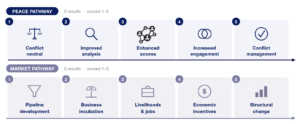
Schematic representation of the +P Framework showing the two pathways of impact
Key Themes and Critiques from the Peer Discussion
The cross-sector dialogue yielded several insights regarding the intersection of impact-investment and peacemaking:
- The Power of “Peace-First” Weighting in Portfolios
Participants from the investment sector joined peace mediation practitioners in affirming that the +P Peace Impact Framework makes a significant contribution to the field. Because the +P Framework prioritizes peace outcomes over economic returns, some impact investments with limited returns should be favoured if they provide significant value to local peacemaking efforts. To make this sustainable, participants envisioned a portfolio approach where low-yield investments are offset by assets that deliver higher financial returns while pursuing less ambitious peace objectives.
- Translating “Peace Impact” into Market Vocabulary
Finance and investment peers highlighted the need to frame peace outcomes in a language that resonates with commercial actors. Participants noted that the peace-supporting impacts identified by the framework could be communicated in mainstream market terminology as downside protection, insurance, risk-mitigation, or de-risking. Demonstrating that peace protects financial assets offers a compelling narrative for institutional capital.
- Moving from “Conflict Neutral” to “Do No Harm”
A point of critique centred on the framing of risk baselines. Colleagues pointed out that labelling an investment as “Conflict Neutral” might mistakenly imply that the market activity has zero effect on the local balance of power or pre-existing conflict dynamics. The discussion suggested that “Do No Harm” is a clearer articulation. It recognizes that market catalysts are rarely neutral, and can worsen a conflict if not managed carefully during design, implementation, and exit.
- Beyond the “Jobs = Peace” Clichés
One of the consensus points was that complex local conflicts cannot be reduced to simplified checkbox metrics such as “jobs = peace”, or “access to finance = peace’. Instead, they emphasized that:
- Marketplace changes must always be mapped directly to a locally-grounded conflict analysis and identified conflict drivers.
- Small-scale local market interventions are frequently more significant for peace than large-scale infrastructure projects or finance streams.
- Economic incentives should be measured against the prior baseline, acknowledging the ways in which market forces were driving and sustaining violent conflict before the intervention.
- Embracing Non-Linear Logic & Local Networks
Peers affirmed that the pathways to peace and business incubation in complex settings are non-linear and operate within volatile and uncertain environments. To navigate this reality, participants emphasized two operational imperatives:
- Local Reliance: PDI draws upon the networks of trusted peace-making partners who possess decades of in-country experience for both pre-project assessments and continuous monitoring.
- Diverse Perspectives: Evaluating real-world peace impact cannot be done in an analytical silo; it requires integrating viewpoints from multiple sectors and incorporating external validation whenever possible.
Field Proof: Lessons from Real-World PDI Projects
To anchor these discussion points, the roundtable reviewed how these dynamics play out in the field, analyzing two active PDI projects as case studies demonstrating both positive revenue generation and locally-recognised peace impact:
- IorOrganic (Bougainville): A soap enterprise founded by 100 women in the conflict-affected Panguna region. By building a unified supply chain that sources labor and ingredients from rival clans across Central and South Bougainville, the business operates as a trust-building mechanism. Guided by local partner conflict analysis, this cross-clan commercial network has given peace mediators physical access to restricted areas and yielded clearer insights into local peace spoilers.
- CaryO (Colombian Amazon): Operating in Miraflores, Guaviare—a territory impacted by past FARC presence and active dissident networks—this venture works with rural communities to harvest wild cacay nuts. In a region where families face economic pressure to cultivate illicit crops, CaryO expanded its network by 63%. Backed by local mediator insights, this pilot proves that legitimate, conservation-focused local businesses can outcompete conflict-driven livelihoods.
Looking Ahead: Shaping the Shared Methodology
The roundtable concluded with an understanding that establishing a standardized language for peace-impact investing is an iterative journey, and that the +P Peace Impact Framework is not a finalized tool. Collaboration with trusted partners in the coming months will help PDI to test and refine the approach, co-develop context-specific metrics, and share field lessons.
Immediate Next Steps for 2026–2027
- Iterative Field Pilots: PDI will continue work with operational partners to test and adapt impact metrics to match field realities.
- Knowledge Sharing: PDI intends to convene further peer roundtables to share findings and build cross-sector consensus around methods such as the +P Framework among peacemakers, investors, institutional asset managers and mainstream finance actors.
Get Involved
To explore partnership opportunities, co-develop metrics, or learn more about PDI’s advisory services for investments in conflict-affected regions, contact us at info@peacedividends.org.